
Critical Design: Speculative Energy Management futures
What if energy managers actively connected energy consumption and human experiences in ways that focus on comfort and joy, rather than reducing energy bills? What are the alternative tools and mental models that building managers could use to adapt for climate futures? These speculative designs explore tools other than dashboards and spreadsheets could shift the practices and approaches of energy management to be more human centric and utilise different metrics.
Challenging default metrics with speculative dashboards
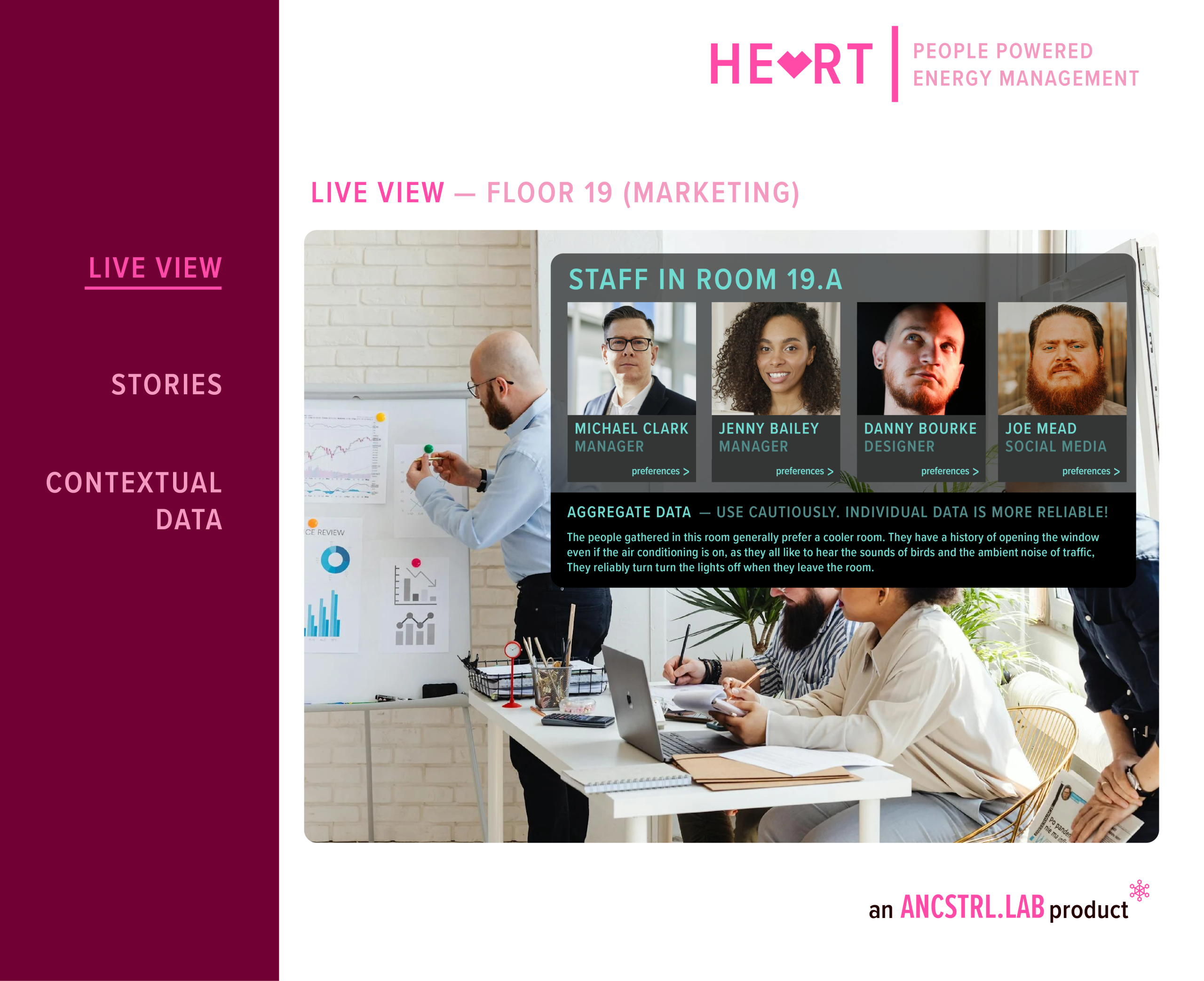 This dashboard offers alternative default metrics for thinking about the energy, comfort, and life of occupants and buildings. In the live view, an energy manager can identify the current inhabitants of a room and contextualise their typical energy usage behaviours. Once an energy manager clicks through to an individual person, they can see an explanation of their typical energy usage patterns and any contextual factors. Here, the live view explains that Michael Clark enjoys a cooler temperature after his morning run. This provides deeper context on the person behind the energy behaviour, and can help energy managers to act with a more granular understanding of the system they’re working within. The contextual data tab of Heart presents energy anomalies and patterns annotated with human and business context to encourage decisions to be made with understanding of factors beyond quantitative data.
ContextSense: more-than-human perspectives on building data
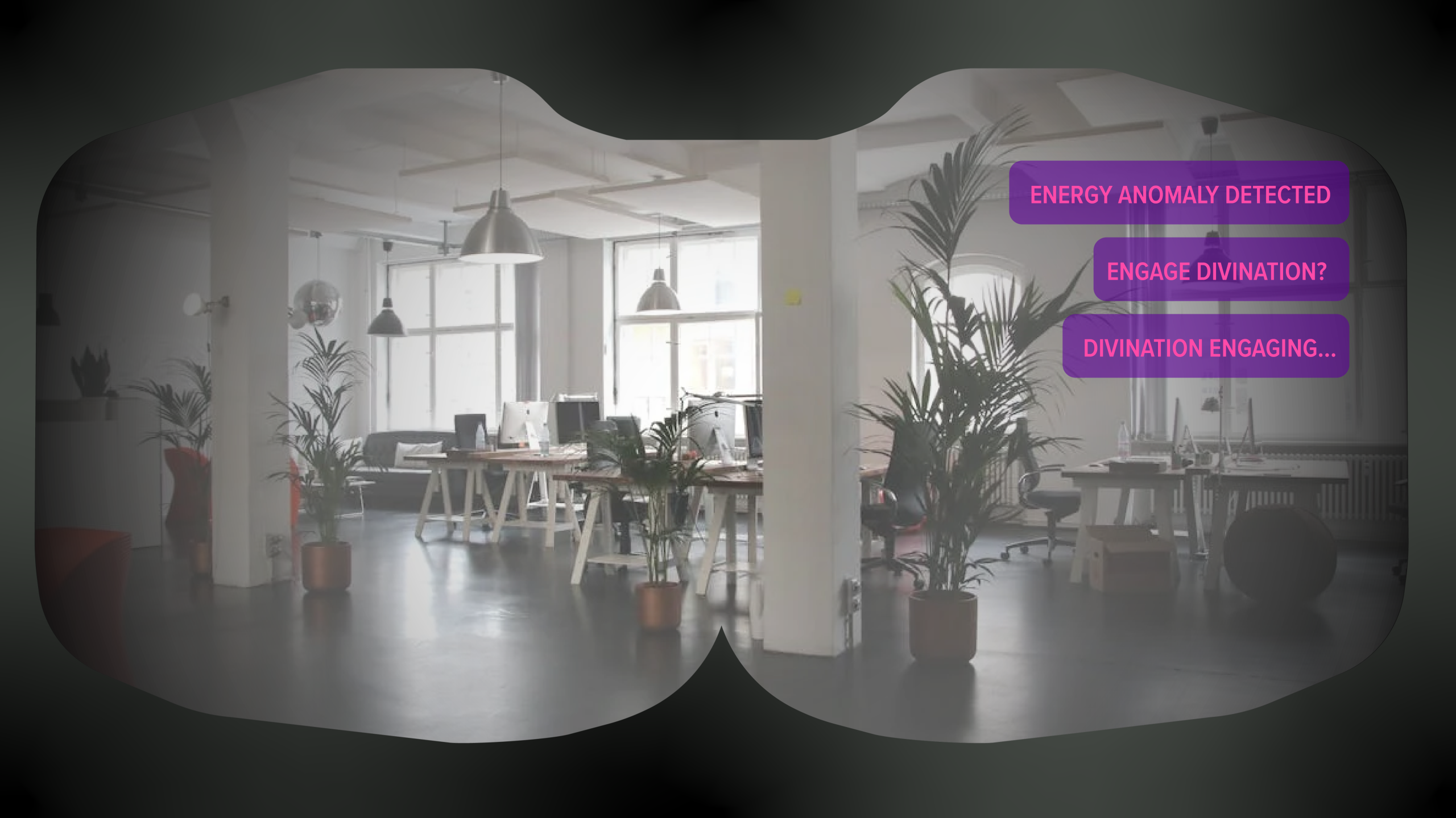
ContextSense asks what other data or signals can help building managers make decisions about the behaviours of buildings and their occupants. The ContextSense headset concept offers a glimpse of possible building management future practices where AI enabled technologies are able to extract data and information in real time by scanning spaces to reduce assumptions and risks when making decisions about energy and building interventions. What if energy stakeholders, through AI-mediated visions, could prefigure interventions to reduce costs and time spend in bureaucratic loops?
Humane Energy Management Handbook – preparing energy managers for climate futures
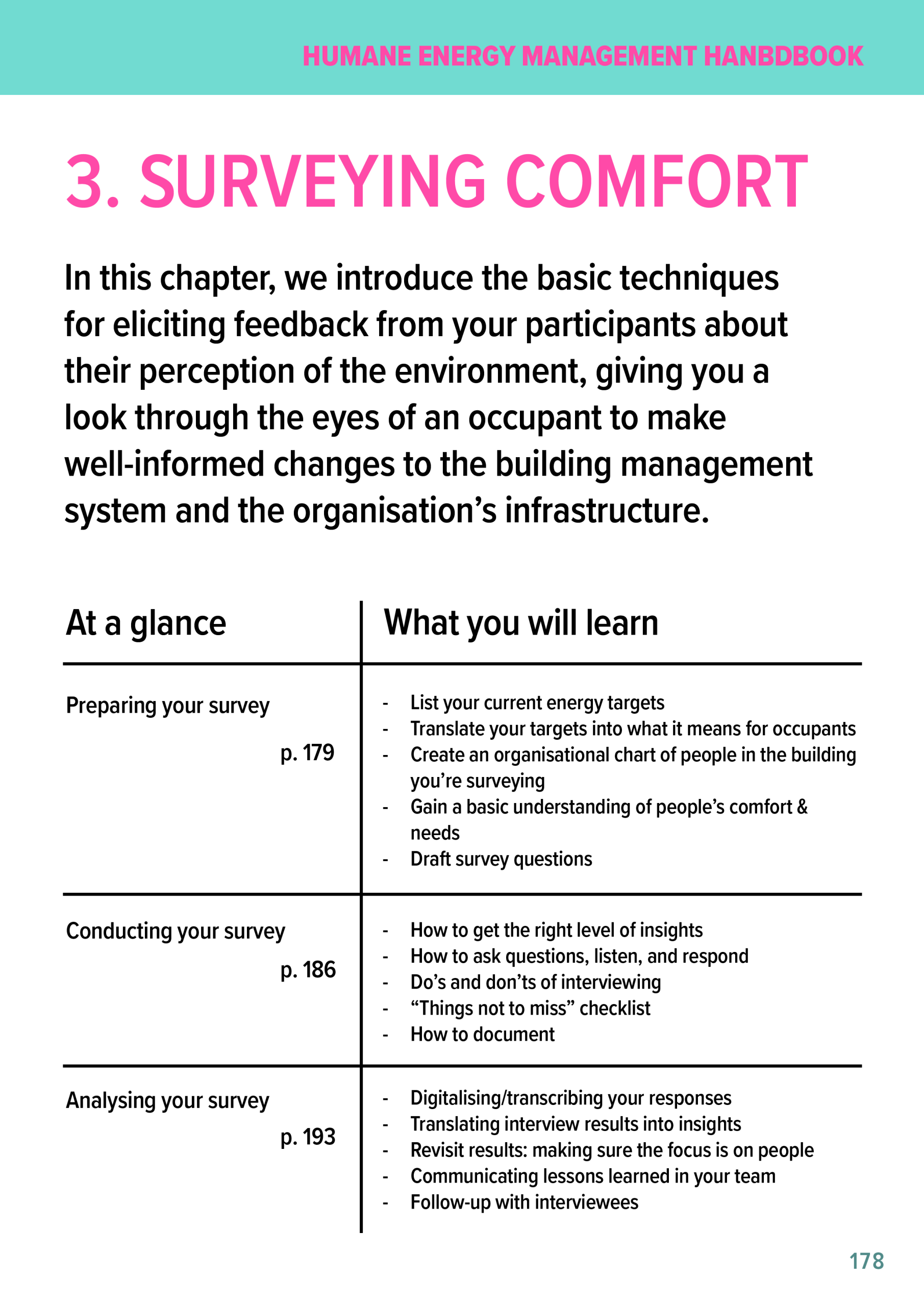
Energy and building managers are trained and educated through a range of directed and self directed learning experiences. The concept of the Humane Energy Management Handbook looks to take the traditional STEM and quantitative educational experiences of the energy/building manager and supplement them with systems thinking, qualitative data collection and analysis, and a new set of tools that can more holistically consider designing and intervening in the built environment in ways that consider alternative metrics and measures such as productivity, comfort, and climate change preparedness.
Humane Energy Management Handbook: In this new 260 page handbook you will find a series of examples and exercises to help you prepare for and conduct your survey—understanding who or what is responsible for meeting people’s needs. In 6 weeks you’ll be a certified Humane Energy Management Expert.
Considering the lesser known costs of digitalisation in building systems and ICT
As buildings are increasingly digitalised the environmental impacts of ICT become increasingly entangled with the built environment. Through a technosolutionist lens the utilisation of data and AI increase in building systems is a certainty further increasing the lesser known social and environmental costs of ICT. Some headline concerns are:
- The production of ICT equipment consumes materials, and the faster digital technology becomes embedded in other products and services, the more material consumption and reliance on material extractivist practices underpins this.
- Large scale computing facilities, such as hyperscalar data centres, are now sufficiently large energy consumers that they place major burdens on energy grids and drive major energy projects through power purchase agreements.
- This can reduce energy resilience and increase the cost of energy for communities; but it also can displace other energy users who can’t afford to compete for this capacity.
- ICT has indirect links to extractivist practices such as mining and
waste handling, some with questionable labour practices and consequences to human health and for environmental degradation. - Water use (and access) is emerging as an important datacentre concern.
- All of which have unforeseen consequences for organisations and the costs of their energy and the digital services they utilise.
Research through Game Design
Research through Games Design helps explore and create knowledge about systems, through designing, mapping and playing games to experience systems, exposing invisible subsystems and interconnections. Games helped us explore how our focusing on techno-solutions limit the ways that we can intervene in complex (energy) systems. Following a Research through (Games) Design approach that builds on Speculative Design, Critical Design, and Futures Studies our RtGDs 1) help surface new knowledge and perspectives on the dominant imaginaries of energy and facilities management, 2) bring a broad range of people into a design research process, and 3) enable the design of speculative experiences for players grounded in our search for emergent and alternative systems.
Zines
Making a Meal out of a Mountain,
A zine exploring what Research through Games Design can be and how you might use it in your research practice. The zine includes A Supervisor’s Quick Guide to Research through Game Design serving as a living document to support supervisors when working with researchers and students who are making games as part of a Research through Design approach.
Games
Optimise!
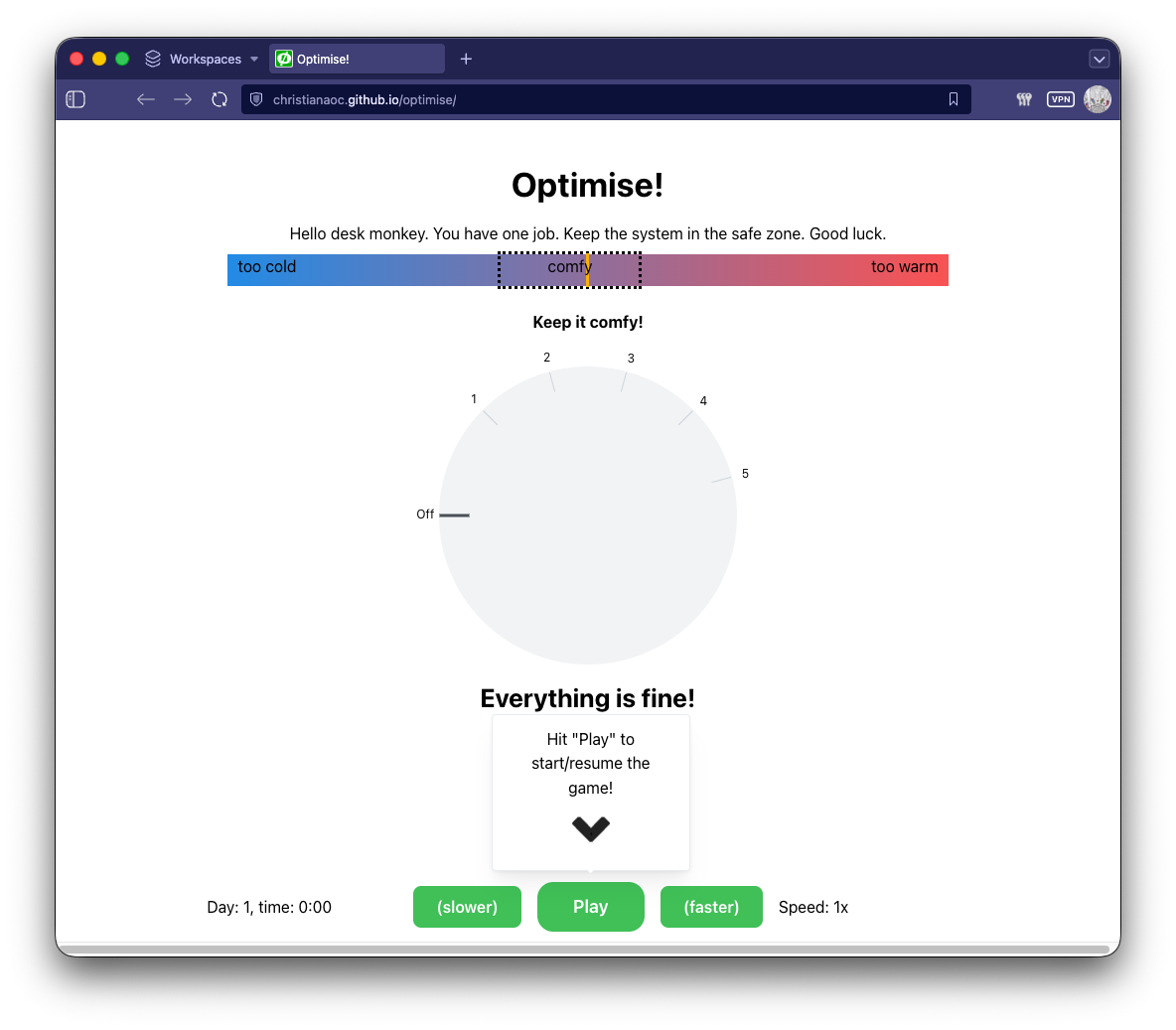
A game, interactive narrative systems, and playful exploration of energy systems and user expectations. Through the short gameplay loop of Optimise! the norms and affordances of the thermostat will warp and change, revealing what goes on beyond the dial. Optimise as a game design seeks to incrementally explore the complexity of optimising (Energy) systems through gameplay. Optimise also acts as sandbox for quickly playing with the parameters of energy control systems and peaking at the system behind sites of interaction.
The game is designed for Web browsers and is currently not compatible with mobile.
NotZero
NotZero is a rules-light story-creation game where players uncover how businesses used ICTs and other means to enact or resist organisational energy and carbon reduction policies. Play as a Climate Anthropologists, from the future, researching how organisations responded to net zero policies with ICT.
Energy Divination
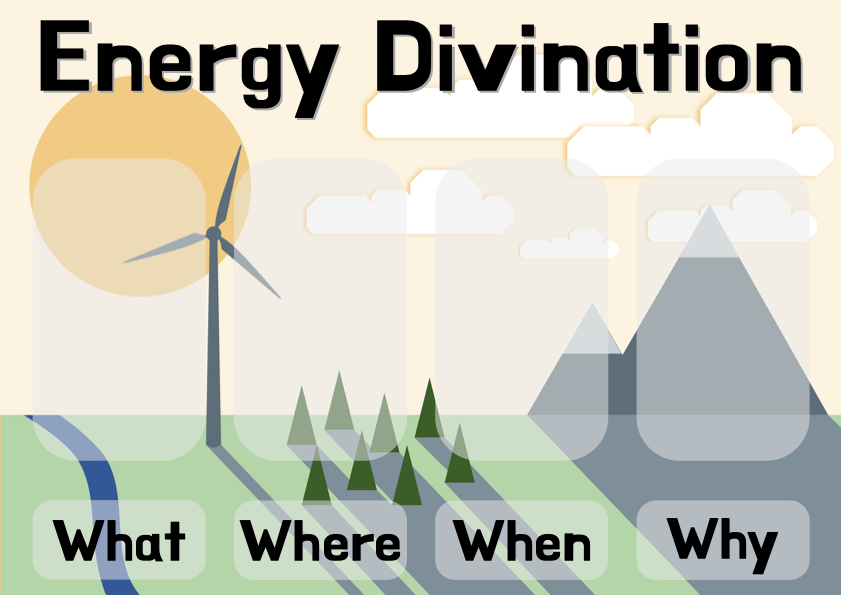
Energy Divination is a quick visual prompt game about using only visual information to predict energy futures. It encourages an alternative approach and perspective to the data-centric thinking that happens in energy research and ICT interventions.
Thinking differently about the work of sustainable ICT through the Two Loops model of change
The multiple unfolding crises that threaten life on Earth keep many of us awake at night and leave us at a loss about how to meaningfully respond. Much of humanity’s efforts to address the crises are ultimately aimed at upholding the current unsustainable paradigm of infinite growth and exploitation of both natural resources and humans. In this paper, we offer the Two Loops model of change as a framework for understanding the interrelated crises of our times – the meta-crisis – to help us find clues for personal agency and also hope. Notably, Two Loops asks us to face the need for hospicing and grieving what is dying, reorienting computing to work to what comes after and what must be protected and saved. We work through the model’s various spaces for agency, i.e. innovating, naming, connecting, nurturing, illuminating in the emergent System; and stewarding, hospicing, composting and transitioning in the dying dominant System. We suggest examples and clues as to where computing and HCI professionals’ agency might lie in and between the two Systems in terms of skills, tools, practices and projects. Moving forward, we welcome a deeper, large-scale collaborative mapping of the possible contributions of our profession, to include all the different specialisms of our field in the picture of how we can be of service to liveable futures.